Raven’s Matrices Test:
Find the Rule, Fill the Gap
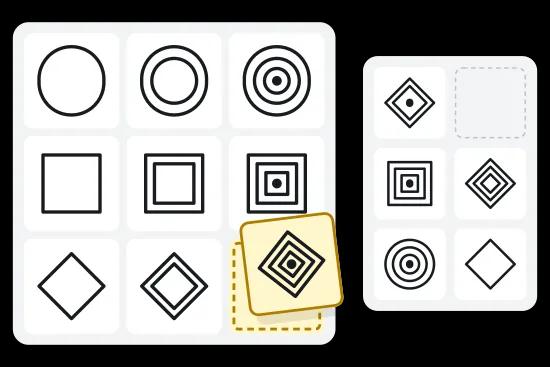
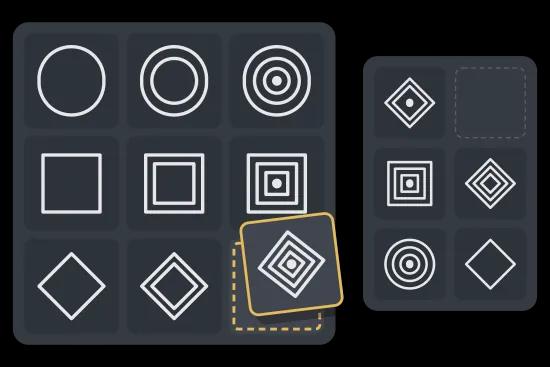
Every matrix is missing one cell: spot the rule that changes the shapes across rows and columns, then pick the piece that fits. The puzzles follow the model of Raven’s Progressive Matrices and test nonverbal reasoning with no words or numbers.
original puzzles on Raven’s model
What you get
The report opens right after the test, and you can save it to your profile
- Score out of 60 and a levelHow many matrices you solved and which of five levels that puts you at, from starting to top.
- A five-skill profileA separate score for each set: completion, analogies, progressions, arrangements, adding and subtracting. You can see which rules come easily and which don’t yet.
- PaceTotal time and seconds per puzzle, with a note on whether your pace helped or got in the way.
- Every mistake explainedYour pick, the right answer and the rule the puzzle was built on, in plain words.
- A result cardA 60-cell mosaic with your score and level. Save it to your account or send it to friends.
Five sets, five kinds of rules
The sets get harder as you go, and so do the puzzles inside each one: by the end of a set, two or three features change at once instead of one.
Completion
Seeing the whole pattern
12 puzzles, 6 answer options
Analogies
Carrying a rule from one pair to another
12 puzzles, 6 answer options
Progressions
Noticing step-by-step change
12 puzzles, 8 answer options
Arrangements
Spotting the same set in a different order
12 puzzles, 8 answer options
Adding and subtracting
Combining and taking apart shapes in your head
12 puzzles, 8 answer options
Solve a matrix right here
One puzzle from each set. They aren’t part of the test, so feel free to try them and peek at the rule.
Completion
Seeing the whole pattern
A large pattern with a piece cut out: stripes, checks, waves, dots, or a mix. You pick the piece that carries the design on without a seam.
Pick the missing piece
How the test works
- 1Look at the whole matrixIn every puzzle the shapes follow a rule across rows and columns, and one cell is empty. Find the rule and pick the piece that carries it on.
- 260 puzzles, no time limitFive sets of 12, from a simple pattern to combining shapes. Plan on about 20 minutes, but there’s no need to rush: only correct answers count, and the clock just keeps a record.
- 3Your result right awayAfter the last puzzle you see your score, level, set profile, pace and a review of your mistakes. Save it to your account or share the card.
Before you start
- Find a quiet spot and twenty minutes without interruptions. A break in the middle of a set makes it easy to lose the rule you just found.
- Use a bigger screen, a laptop or a tablet. A phone works too, but small details in the shapes are easier to miss.
- Find the rule and picture the missing shape first, then look at the options. Some of them look right but fit only one feature.
- Once you’ve picked an option, check it against both the row and the column.
- Take your time. There’s no timer, only correct answers count, and you’ll simply see your time in the result.
Method and sources
Where the test comes from and how the result is scored
The first account of the puzzles that became the matrices was published in 1936 by psychologist John Raven and geneticist Lionel Penrose. The standard form, the Standard Progressive Matrices, followed in 1938: 60 puzzles in five sets of 12, getting harder within each set and from set to set. Raven meant the matrices to measure “eductive” ability from Charles Spearman’s theory of general intelligence, the knack of drawing relationships out of unfamiliar material. The original is untimed, and its publisher sells it to qualified professionals only.
You won’t find scans of the original here: its puzzles belong to the publisher. All 60 matrices were drawn by the Prisamor generator on the same plan: five sets of 12, with 6 answer options in sets A and B and 8 in sets C, D and E. The rules of the 3×3 matrices in sets C, D and E follow the published classification by Carpenter, Just and Shell (1990): constancy in a row, progression, distribution of three values, and adding and subtracting shapes. Building new puzzles from the rules instead of copying old ones is standard practice in research (for example, Matzen et al., 2010). A program checks every puzzle to make sure exactly one option fits.
- What it measures
- The matrices test nonverbal reasoning: spotting an abstract rule in unfamiliar material and keeping several rules in mind at once (Carpenter, Just & Shell, 1990). They’re usually classed as fluid intelligence tasks, solving something new rather than applying what you’ve learned. Matrices are closely linked to general intelligence but not the same thing: visual-spatial skills and the design of the puzzles themselves also shape the score (Gignac, 2015). Knowledge, language, memory for facts and emotional intelligence are not part of this test.
- How it is scored
- Each correct answer scores 1 point, for a total of 0 to 60. Every set has 12 puzzles and a score from 0 to 12: 0-5 low, 6-9 medium, 10-12 high. Total score levels: 0-17 starting, 18-31 basic, 32-43 solid, 44-52 strong, 53-60 top. Random guessing gets about 8 or 9 right out of 60 on average, so scores above 17 almost never happen by chance. Pace is based on the average time per puzzle: under 12 seconds is fast, 12-35 is steady, over 35 is deliberate. The level cut-offs reflect which sets and rules you solve, not a comparison with other people.
- Limitations
- These puzzles have no norms yet, so scores aren’t converted to IQ or compared with the general population. Online, your screen, noise, tiredness and breaks all affect the result, while a psychologist gives the test with standard instructions in the same conditions for everyone. Scores usually rise on a second attempt, largely because the rules feel familiar. Matrix scores are linked to education and rose sharply over the 20th century (the Flynn effect), so the test isn’t culture-free: it just leans less on language. Treat the result as a guide for yourself, not an official assessment for school, hiring or diagnosis.
Why there’s no IQ here
IQ describes where a person stands among people their age, and it comes from norm tables built for the exact puzzles they solved. Even the original Raven’s test reports a raw score and a percentile against its own norm group. Our puzzles don’t have norms like that yet, so instead of an invented number you get a score, a level, a set profile and a review of your mistakes.
Sources
- Penrose, L. S., & Raven, J. C. (1936). A new series of perceptual tests: Preliminary communication. British Journal of Medical Psychology, 16(2), 97-104. DOI 10.1111/j.2044-8341.1936.tb00690.x
- Raven, J. (2000). The Raven’s Progressive Matrices: Change and stability over culture and time. Cognitive Psychology, 41(1), 1-48. DOI 10.1006/cogp.1999.0735
- Carpenter, P. A., Just, M. A., & Shell, P. (1990). What one intelligence test measures: A theoretical account of the processing in the Raven Progressive Matrices Test. Psychological Review, 97(3), 404-431. DOI 10.1037/0033-295X.97.3.404
- Matzen, L. E., Benz, Z. O., Dixon, K. R., Posey, J., Kroger, J. K., & Speed, A. E. (2010). Recreating Raven’s: Software for systematically generating large numbers of Raven-like matrix problems with normed properties. Behavior Research Methods, 42(2), 525-541. DOI 10.3758/BRM.42.2.525
- Gignac, G. E. (2015). Raven’s is not a pure measure of general intelligence: Implications for g factor theory and the brief measurement of g. Intelligence, 52, 71-79. DOI 10.1016/j.intell.2015.07.006
- Flynn, J. R. (1987). Massive IQ gains in 14 nations: What IQ tests really measure. Psychological Bulletin, 101(2), 171-191. DOI 10.1037/0033-2909.101.2.171
Who it suits
- Puzzle lovers who want to test their logic on problems without words
- Anyone who has heard of Raven’s test and wants the full 60-puzzle form, not a short sample
- People preparing for abstract reasoning tests in job applications who want to see how matrices work
- Anyone curious which kinds of rules come easily and which don’t
Raven’s Progressive Matrices Test: 60 Puzzles, Explained
What Raven’s Progressive Matrices are
The Progressive Matrices were created by psychologist John Raven. He first described the puzzles with geneticist Lionel Penrose in 1936, and the standard form came out in 1938: 60 drawings in five sets of 12. They’re called “progressive” because the puzzles get harder bit by bit, within each set and from one set to the next. In every puzzle the shapes follow a rule, one cell is empty, and you pick the option that carries the rule on.
Psychologists still work with Raven’s method, and the original booklet is published and sold to qualified professionals only. Many free versions online use scans, while ours are original: the same five sets and the same kinds of rules, with every drawing made from scratch. You can take this Raven’s matrices test online for free, with no sign-up, on a computer or a phone.
What Raven’s test measures
Raven’s matrices look at one side of intelligence: nonverbal reasoning. You have to see an abstract rule in an unfamiliar picture and hold several rules in mind at the same time. Carpenter, Just and Shell (1990) studied how people solve matrices through think-aloud reports, eye movements and errors, and found that these two abilities are what mainly set solvers apart. Matrices are usually classed as fluid intelligence tasks: working out something new rather than recalling something learned.
What it doesn’t measure
Vocabulary, knowledge, memory for facts, people skills and emotional intelligence don’t enter the score. Matrices are closely tied to general intelligence, but they aren’t a pure measure of it: visual-spatial skills and the design of the puzzles also play a part.
Raven’s test and IQ: why we don’t print a number
IQ isn’t the number of right answers. It’s where you stand among people your age. To calculate it, a large sample solves the puzzles first, and their results become norm tables for each age group. Even the official matrices report a raw score and a percentile against their own norm group, and IQ comes from converting that. Older tables are also out of date: average matrix scores rose sharply over the 20th century (the Flynn effect), so they inflate today’s IQ.
Our puzzles are different, even though they follow the same model, so other tests’ tables don’t apply. If a site promises an exact IQ from its own puzzles, it’s worth asking what sample its norms came from. We show what can be calculated honestly: a score out of 60, a level, a set profile and a review of your mistakes.
Reading your result and what counts as a good score
Each correct answer is worth 1 point. Random guessing averages about 8 or 9 out of 60, so a score above 17 almost always means you’re finding the rules. From there, levels follow the sets you solve: at basic, patterns and simple analogies come reliably; solid adds progressions; strong adds arrangements with several features; top covers nearly all of the adding and subtracting set.
The set profile shows which kind of rule comes more easily. Read your pace together with your score. A fast pace with mistakes at the end of sets suggests you needed another minute to check. A slow pace with a high score points to care, not slowness.
How to solve Raven’s matrices
Researchers describe two approaches. You can build the answer in your head first and then look for it among the options, or you can go through the options and rule out the ones that don’t fit. Ruling out is more likely to lead you into traps: some options look right but match the rule on only one feature. A few habits that help:
- Break each shape into features: number, form, size, shading, position. For each one, ask whether it changes and how.
- Look along rows and down columns. In arrangements, the rule is sometimes visible only from top to bottom.
- In the last set, compare the lines of the shapes in a row: which appear in both of the first two, which in only one, which disappear in the third.
- Once you’ve picked an option, check it against every row and column, not just the cell next to it.
Can you train for it, and does education matter?
Scores usually go up on a second attempt, but largely because the rules are familiar, not because intelligence has grown. Working memory training, according to meta-analyses, barely carries over to matrix scores. When you compare your attempts, allow for the fact that you’ve seen the puzzles before.
Matrices lean on language less than most tests, but they aren’t culture-free. Scores are linked to access to education and have risen from one generation to the next. The test is a good way to look at your own wordless logic, not a way to compare people across countries or eras.
Common questions about Raven’s test
What IQ does Raven’s test give?
Raven’s test doesn’t produce an IQ on its own. Even the original form gives a raw score and a percentile against a specific norm group, and IQ figures come from converting that with tables for age and country. Our puzzles don’t have such norms yet, so you won’t see an IQ here: any number would be made up. Instead you get a score out of 60, a level, a set profile and a review of your mistakes.
How many questions are on Raven’s Progressive Matrices?
The standard form has 60 puzzles in five sets, A, B, C, D and E, with 12 in each. Ours follows the same layout, with 6 answer options in the first two sets and 8 in the rest.
How long does Raven’s test take?
The original is untimed and usually takes 20 to 45 minutes. There’s no timer here either; plan on about 20 minutes. Your total time and average time per puzzle show up in the result.
What does Raven’s Progressive Matrices measure?
The ability to spot a rule in an unfamiliar picture and keep several rules in mind at once, in other words nonverbal reasoning. It’s usually counted as fluid intelligence. The test is closely linked to general intelligence but not identical to it, and it doesn’t test knowledge, language or emotional skills at all.
What is a good score on Raven’s matrices?
Random guessing gets about 8 or 9 right out of 60, so anything above 17 already means you’re finding the rules. From there, levels depend on which sets you solve: 32-43 is solid, 44-52 strong, 53 and up top. These scores can’t be compared with the original test’s tables, because the puzzles are different.
Is this the official Raven’s test?
The model is the same: 60 puzzles, five sets, the same kinds of rules and the same rise in difficulty. The drawings are our own, made by the Prisamor generator, because the original puzzles belong to the publisher and are sold to qualified professionals only. So this is an original test built on Raven’s model, not a copy of the booklet.
Can you practice for Raven’s matrices?
Scores usually rise on a second attempt, largely because the rules feel familiar. Working memory training, on the other hand, barely carries over to matrix scores, according to meta-analyses. The best preparation is simple: get a good night’s sleep, use a bigger screen and don’t rush.
Where can I see the answers to Raven’s test?
After the test, every mistake shows your pick, the right answer and the rule the puzzle was built on. There are no answers to the original booklet or to any employer’s test here: the puzzles are different.
Find the rule in 60 matrices
Five sets, from patterns to combining shapes, about twenty minutes with no timer. Right after the last puzzle you’ll see your score, level, set profile, pace and every mistake explained.
Free, no sign-up needed.