16
Numbers
16 tasks on sequences, operations, rates and proportions. Find a rule, then check it against every number in the condition.
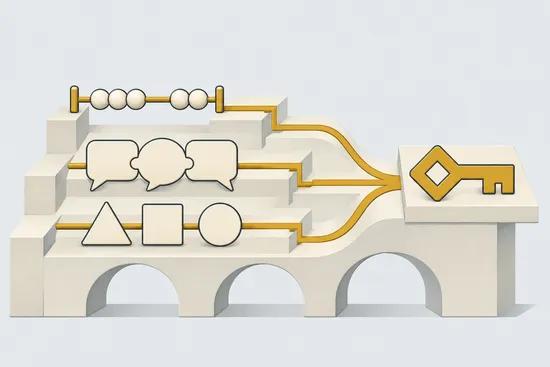
16 tasksA number sequence, a link between words and a turning shape ask you to reason in different ways. Try 40 original Prisamor puzzles in the tradition of Eysenck's mixed tests. See what you solved and why; this is reasoning practice, not an age-normed IQ assessment.
The report opens right after the test, and you can save it to your profile
Look for numerical relationships, keep the exact meaning of a condition and follow a changing drawing. Each group needs its own way of checking.
16 tasks on sequences, operations, rates and proportions. Find a rule, then check it against every number in the condition.
16 tasks12 tasks on analogies, order and necessary conclusions. Preserve the relationship and watch words such as all, some and only if.
12 tasks12 tasks on turning, reflecting, combining and moving shapes. Track direction, position, fill and number separately.
12 tasksWhere the test comes from and how the result is scored
A sequence of numbers, a relationship between words and a changing shape require different kinds of checks. This Eysenck IQ practice set brings those tasks together so you can inspect the way you solved them. The result includes your number of correct answers, a profile of three groups and a review of each solution. It describes your answers on this set rather than defining your intelligence.
The questions, diagrams, order and scoring were created for Prisamor. The historical reference is the mixed reasoning format made familiar by Eysenck's popular puzzle books, not a claim that these are his original questions.
These names can lead to different expectations. Raven's matrices focus on visual patterns. This set adds number relationships and verbal logic alongside drawings. Eysenck's EPI is a personality questionnaire about typical reactions; it has no right answer to each statement. Here the aim is to find one option that follows the rule.
Choose the format that matches what you want to explore. The raw totals from different tests use different tasks and should not be treated as interchangeable measures.
The series contains 16 numerical, 12 verbal-logic and 12 visual tasks. There are four options per question. Plan a quiet half hour, work without a calculator or outside help, and use paper if a small calculation or sketch helps. You can revisit your answers before submitting.
Thirty minutes is a suggested pace, not a countdown that ends the attempt. Time is recorded separately and does not add or remove points. This makes the set useful for practice without pretending to reproduce an original standardised administration.
Each correct answer earns one point, giving a total from 0 to 40. The five levels divide this set into published score ranges; they are editorial descriptions, not a ranking against other people. The three group scores also report the share solved, so a group with 16 tasks can be compared fairly with a group of 12.
These new tasks have no representative age norms. Converting their total through another test's table would add a number without establishing its meaning. The result therefore contains neither an estimated IQ nor a population percentile. It is not suitable for diagnosis, recruitment or judging another person's ability.
The review shows the original condition, your option, the keyed answer and the reasoning behind it. For a number sequence, check that the operation fits every step. For a verbal conclusion, distinguish what must follow from what could be true. For a drawing, track direction, fill, position and number of elements separately.
Begin with a correct and an incorrect answer from the same group. Their difference can reveal the precise step to practise. The aim is to understand a rule well enough to use it again, rather than to remember the letter or position of an answer.
Once you have read the solutions, this set is no longer unfamiliar. A higher second score may reflect remembered answers or a better understanding of the format. It does not independently demonstrate an increase in general intelligence.
Use the practice suggestions to try the method on fresh questions. Compare a price using its correct percentage base, check a conclusion with a counterexample, or apply a rotation to a different shape. If you share your card with a friend, compare the tasks and approaches rather than treating a few points as a judgement about either person.
It is an original Prisamor practice set in the tradition of mixed reasoning puzzles associated with Hans Eysenck. The 40 tasks combine numbers, verbal logic and shapes. It is not a reproduction of his original tests or a validated adaptation.
There are 40 tasks with four options each: 16 numerical, 12 verbal-logic and 12 visual. Allow about 30 minutes. There is no enforced cutoff, and time does not change your score.
Yes. Your score, three profiles and explanations of all 40 tasks are free and appear after completion. You can sign in if you want to keep the attempt in your account, but registration is not required to read the result.
The completed result includes every question, your choice, the correct option and its rule. Visual tasks keep their drawings and answer options beside the explanation. You can switch between missed tasks and the full review.
These are new tasks without representative age norms. Another test's conversion table would not establish your IQ on this set. We show the correct answers and profile that can be calculated directly, without an invented IQ number or population percentile.
Raven's matrices use drawings to test visual rules. This practice set combines numerical relationships, verbal logic and shapes. You can try both formats to explore different tasks, but their raw scores cannot be compared as if they used the same scale.
No. Eysenck's EPI questionnaire asks about your usual reactions and describes temperament. Here you solve tasks with keyed answers. The two formats share a historical name but answer different questions.
You may, especially after reading the explanations. You will then know some of the rules and answers, so a higher score does not by itself show a rise in intelligence. Use new problems to check whether a solution method carries over.
Numbers, verbal logic and shapes, about thirty minutes. The score, group profile and full explanations are free, with no registration needed to read your result.
Free, no sign-up needed.