Am I a Difficult Person?
Eight Traits on One Chart
Forty questions about how you act in an argument, after a hurt, and when you’re tired: how fast you flare up, how long you hold a grudge, how easily you give way, plus five more traits that make someone hard to get along with. Your answers form a circular chart of eight traits and a difficulty score from 0 to 100, and the shape shows your character: easygoing, even-keeled, complex, difficult, or sharp on one side. About 7 minutes, free, with your result right away.

What you get
The report opens right after the test, and you can save it to your profile
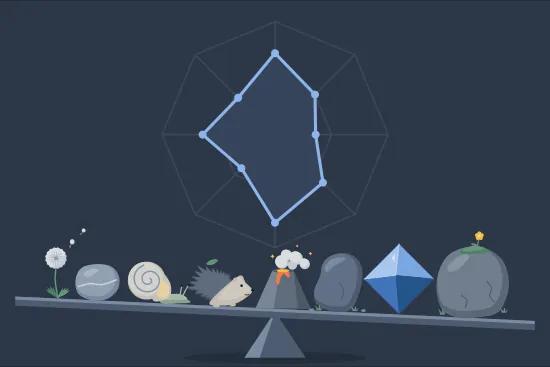
- A circular chart of eight traitsTemper, moodiness, touchiness, distrust, stubbornness, control, fault-finding, and bluntness, each with its own number from 0 to 100. One look at the shape tells you where your character sticks out.
- A difficulty score from 0 to 100One number that answers the question in the title. Up to 37, you’re mostly easy to be around. From 63 up, people find you hard going in several areas at once.
- Your type out of eightEasygoing, Even-keeled, Complex, Difficult, or one of four flavors: Explosive, Sensitive, Headstrong, Prickly. Lay the outline of any type over your shape to see which one is closest and which is furthest away.
- Your most telling answersUp to three of your own answers where the difficulty shows most, with how it looks from the outside and one small thing to try.
- Your character in real lifeWork, family, friends, fights, and love: where you’re easy to be around, where sparks fly, and what to do about it.
- A plan for the weekSeven short steps for your type, one a day. Nothing heroic: a pause before you reply, one compliment in place of a correction.
Eight types from easygoing to difficult
Four types describe overall difficulty: Easygoing, Even-keeled, Complex, and Difficult. Four more show a flavor, when one pair of traits stands well above the rest: Explosive, Sensitive, Headstrong, and Prickly. None of them is a verdict. Prickly people are honest, headstrong ones don’t give up, sensitive ones notice what others miss, explosive ones never fake a feeling, and the result says so plainly.
Easygoing
Score of 37 or below: calm, even, and no hidden agenda.
Even-keeled
Everything in moderation: you have your reactions, but no sharp edges.
Complex
High traits in more than one pair: a personality with several sides and some sharp edges.
Difficult
Score above 62: your traits run strong, and people often find you hard going.
Explosive
Temper and moodiness run highest: you boil over fast and your mood swings.
Sensitive
Touchiness and distrust run highest: you’re easy to hurt and slow to trust.
Headstrong
Stubbornness and control run highest: you hold your ground and want things done your way.
Prickly
Fault-finding and bluntness run highest: you see flaws and say so directly.
Eight traits of a difficult personality
- Temper5 questions
How quickly irritation turns into an outburst: a raised voice, a slammed door, a sharp word for whoever happens to be nearby.
Easy sidecalm, irritation rarely turns into shoutingHard sideboiling over in seconds, voice raised
For example: “When someone cuts in front of me in line, I go from calm to furious in seconds.”
- Moodiness5 questions
How sharply your mood shifts and how hard it is for others to guess what you’ll be like in an hour.
Easy sidea steady mood, easy to readHard sidesunny at breakfast, stormy by lunch
For example: “I can start the day in a great mood and be grumbling at everyone by lunch for no clear reason.”
- Touchiness5 questions
How easily small things hurt you and how long the hurt lasts.
Easy sidequick to let go, hurts don’t pile upHard sidesmall things sting and stay with you
For example: “Even a small offhand remark can sting me.”
- Distrust5 questions
How much you expect a catch, look for hidden motives, and double-check what people tell you.
Easy sidetrust: people are honest until proven otherwiseHard sidelooking for the catch in every favor
For example: “When someone I barely know does me a favor, I assume they’re about to ask for something.”
- Stubbornness5 questions
How hard it is to admit you were wrong, take advice, or go back on a decision.
Easy sideflexible, changing your mind is fineHard sideadmitting you were wrong feels like torture
For example: “Admitting out loud that I was wrong feels almost painful, even when it’s obvious.”
- Control5 questions
How much you need things done your way: deciding for everyone, keeping the wheel, taking tasks from people who do them differently.
Easy sidepartnership, decisions are sharedHard sideonly your hands on the wheel
For example: “On a trip with friends, I feel more at ease when I’m the one deciding the route and the plans.”
- Fault-finding5 questions
How much you notice other people’s slips, correct them, and how hard you are to please.
Easy sidetolerant of other people’s slipsHard sidefirst to spot the mistake and point it out
For example: “In someone else’s report, slides, or home renovation, the mistakes are the first thing I see.”
- Bluntness5 questions
How directly you say unpleasant things and how often your words hurt more than you meant.
Easy sidetact, bad news delivered gentlyHard sidesaid straight, no cushioning
For example: “If I don’t like a gift or someone’s new haircut, I say so without softening it.”
How the test works
- 140 statements about how you get along with peopleWaiting in line, work chats, a trip with friends, someone else’s renovation, a family argument. Each statement has five answer options, so “somewhat” is a perfectly honest choice. The whole test takes about 7 minutes.
- 2How it is, not how you’d like it to beIt’s tempting to answer as your best self, the one who slept well and is on vacation. The breakdown only helps if it describes an ordinary Tuesday. There are no good or bad answers here.
- 3Your answers become a shapeEach trait gets five statements, one of them worded the other way round. Neighboring traits on the chart come in pairs: temper with moodiness, touchiness with distrust, stubbornness with control, fault-finding with bluntness. Wherever the shape stretches, that’s where your character leans.
- 4Your chart and breakdown right awayAfter the last answer you’ll see your chart, difficulty score, type, a trait-by-trait breakdown, real-life situations, and a plan for the week. You can save the result to your account or share it as a card.
Answer options
- 1Not me at all
- 2Not really
- 3Somewhat
- 4Mostly
- 5That’s me
Method and its limits
Where the test comes from and how the result is scored
- What it measures
- This is an original model. The Prisamor team picked eight everyday traits that make someone hard to get along with and wrote five statements for each. The reference points come from well-studied personality models. In the HEXACO model (Lee and Ashton), agreeableness is set directly against anger and is made up of four facets: forgiveness, gentleness in judging others, flexibility, and patience. Our touchiness, fault-finding, stubbornness, and temper sit close to the opposite ends of those facets. DeYoung, Quilty, and Peterson (2007) showed that neuroticism has an aspect called Volatility (irritability, anger, trouble holding back an impulse) and agreeableness has one called Politeness (respect for other people’s needs rather than pushing your own); temper, moodiness, bluntness, and control draw on these two aspects. Scales with similar content for anger, trust, and cooperation exist in the open International Personality Item Pool, IPIP (Goldberg et al., 2006). The wording of our statements is our own.
- How it is scored
- Each answer is worth 0 to 4 points. Every trait has one reversed item out of five, where disagreeing points toward difficulty. A trait is the average of its five answers, converted to a 0-100 scale. Levels: up to 37 low, 38-62 moderate, 63 and above high. The difficulty score is the average of the eight traits. A score up to 37 gives the Easygoing type, above 62 the Difficult type. In between, the test looks at pairs of neighboring traits. If one pair is at least 10 points above the overall score and at least 8 points above the next pair, your type takes its flavor (Explosive, Sensitive, Headstrong, or Prickly). If high traits show up in two different pairs, you’re Complex; with no sharp edges, you’re Even-keeled. Your closest and opposite types come from the distance between your shape and the reference shapes of the eight types.
- Reliability
- 40 original statements, five for each of the eight traits
- One reversed statement per trait, to catch a habit of agreeing with everything
- Five answer options, from “not me at all” to “that’s me”
- No norms or reliability study yet
- Limitations
- There’s no scientific questionnaire for a “difficult personality”: it’s an everyday phrase, and this model is our own. It has no norms, no percentiles, and no reliability study, so the scores describe your answers, not where you stand among other people. It’s a self-report: after a rough week your chart will look sharper than after a vacation, and the people close to you may see you differently. The test doesn’t diagnose anything and isn’t meant for rating someone else.
- Sources
- Lee, K., & Ashton, M. C. (2004). Psychometric properties of the HEXACO Personality Inventory. Multivariate Behavioral Research, 39(2), 329-358. DOI 10.1207/s15327906mbr3902_8
- Ashton, M. C., & Lee, K. (2007). Empirical, theoretical, and practical advantages of the HEXACO model of personality structure. Personality and Social Psychology Review, 11(2), 150-166. DOI 10.1177/1088868306294907
- DeYoung, C. G., Quilty, L. C., & Peterson, J. B. (2007). Between facets and domains: 10 aspects of the Big Five. Journal of Personality and Social Psychology, 93(5), 880-896. DOI 10.1037/0022-3514.93.5.880
- Goldberg, L. R., Johnson, J. A., Eber, H. W., Hogan, R., Ashton, M. C., Cloninger, C. R., & Gough, H. G. (2006). The International Personality Item Pool and the future of public-domain personality measures. Journal of Research in Personality, 40(1), 84-96. DOI 10.1016/j.jrp.2005.08.007
Who it suits
- Anyone who’s heard “you’re impossible” and wants to know what’s behind it
- People who notice their own outbursts, grudges, or stubbornness and wonder how much others feel it
- Couples and families: take it separately and compare chart shapes
- Managers who care what it’s like for their team to work with them
- Anyone looking for a personality test with a circular chart
Practical Value
- A circular chart of eight traits and a difficulty score
- Your type out of eight: strength, weak spot, and how you are with people, at work, and in love
- Your closest and opposite types, with their shapes laid over yours
- Each trait broken down by level, with one step to try
- Your most telling answers, five real-life situations, and a seven-day plan
A difficult personality and what it’s made of
What is a difficult person?
In everyday talk, it’s the person you have to tiptoe around. They flare up over small things, remember a bad joke for weeks, won’t budge even on where to get lunch, or correct everyone who speaks in front of them. Psychology has no formal term for a “difficult person” and no questionnaire with that name. What it does have is solid research on the traits behind it: mostly low agreeableness (little patience, flexibility, or readiness to forgive) and emotional volatility that spills outward. This difficult person test breaks the everyday label into eight specific traits and shows them on a circular chart.
Signs of a difficult personality
Plenty of people have one of these traits. Someone becomes hard to get along with when several of them run strong at once.
- Temper: a few seconds from irritation to shouting.
- Moodiness: the people around you have to guess which version of you showed up today.
- Touchiness: an offhand remark stings, and the grudge lasts for weeks.
- Distrust: every kindness looks like it has strings attached.
- Stubbornness: admitting you were wrong feels physically hard.
- Control: you only relax when you’re the one deciding.
- Fault-finding: in someone else’s work, the mistakes jump out first.
- Bluntness: you tell the truth as it is and notice the damage later.
On the chart, neighboring traits sit in pairs. Temper and moodiness make the Blast, touchiness and distrust the Wound, stubbornness and control the Wall, fault-finding and bluntness the Thorns. If your shape stretches toward one of them, your character has a flavor, and the test names it.
Difficult or complex: what’s the difference?
People use the two words interchangeably, but here they mean different things. A complex character is uneven: sharp edges in one pair of traits, softness in another. Someone like that can be easy at home and impossible in a work dispute, generous with friends and wary of strangers. A difficult character is difficult across the board: a score above 62 and friction in many areas at once. In between sits the even-keeled type, with reactions but no sharp edges, plus four flavors where a single pair stands out. Anyone scoring 37 or below gets Easygoing.
Living with a difficult personality
Traits are fairly stable. Behavior isn’t, and behavior is what other people see. Small habits work better than a resolution to “become a different person.” A ten-second pause before you answer defuses a good share of blow-ups. Asking “did I get that right?” heads off half of all hurt feelings. And “you were right” costs far less than a stubborn person expects.
It helps to know your risky hours. Many people snap in the evening, on an empty stomach, or after a bad night, so important conversations can wait. There’s also no need to fight the whole trait: blunt people are honest, fault-finders keep standards high, and stubborn ones finish what they start. The goal is for that strength to land less often on the people you love.
How to get along with a difficult person
Start by working out which trait is causing the trouble. With a hot-tempered person, “let’s come back to this in an hour” works, because arguing at the peak goes nowhere. With a touchy one, say the obvious out loud and skip the ambiguous jokes. With someone stubborn or controlling, agree on areas where each of you decides instead of fighting over every detail. A fault-finder may need reminding that “good” is sometimes good enough. And a blunt person often has no idea their words hurt, so tell them calmly.
You can also ask them to take the test and compare charts. Talking about the shape of a chart tends to go better than talking about “your awful personality.” If outbursts turn into insults, threats, or control over your life, though, this stops being about personality: protect yourself and reach out for help.
How this differs from a character accentuation test
Accentuation tests, such as the Schmieschek questionnaire, describe exaggerated character traits based on Karl Leonhard’s work: demonstrative, pedantic, excitable, “stuck” and others, ten types in all. They give a detailed portrait of temperament and personality, and if that’s what you want, the Schmieschek questionnaire is on this site too. The difficult person test is narrower. It answers one question, how hard you are to get along with and which traits make it so, and shows the answer in a single picture.
Common questions about difficult personalities
How do I know if I’m a difficult person?
Ask yourself less “am I a good person?” and more “what is it like to live with me?” The test asks that forty times in concrete situations: a line at the store, an argument about the route, someone else’s typo in a report. You get the answer two ways. The difficulty score from 0 to 100 shows how much there is overall, and the shape of the chart shows where. Two people who both score 50 can be nothing alike: one flares up and cools down fast, the other never raises their voice but never gives an inch either.
What does the difficulty score mean?
It’s the average of the eight traits, from 0 to 100. Up to 37, judging by your answers, you’re generally easy to be around. From 38 to 62, your character has some edges, and the test shows which ones. Above 62, people find you hard going in several areas at once. The score describes your answers, not your rank among other people: the test has no norms.
Why a circular chart, and how do I read it?
A circle shows all eight traits at once, so you can spot the sharp edge of a character in a second. The farther a point sits from the center, the stronger the trait. Neighboring axes come in pairs: temper and moodiness, touchiness and distrust, stubbornness and control, fault-finding and bluntness. A small, even shape near the center means Easygoing, a large, even one means Difficult, and a shape stretched to one side gives a flavor. Below the chart you can lay the outline of any of the eight types over your own.
Can a difficult personality change?
Traits are fairly stable, but behavior changes, and behavior is what other people actually see. Pausing before you reply, checking that you understood someone, saying “you were right” out loud: these are skills like any other. On average, people also get calmer and more accommodating with age. The weekly plan in your result is built from small steps like these, and retaking the test in a couple of months will show whether your shape has moved.
Is being a difficult person a diagnosis?
No. It’s an everyday phrase, and the test describes habitual reactions, not health. A high score doesn’t mean a personality disorder, and a low one doesn’t promise you’re never hard to deal with. If anger, grudges, or suspicion get in the way of your own life, talking to a therapist is a perfectly ordinary step, not a last resort.
Is this a scientific test?
No. It’s an original method, and we say so openly. The eight traits and the wording come from the Prisamor team, with well-studied personality models as reference points: HEXACO and the ten aspects of the Big Five. Clinical research on difficult behavior looks at something else, antagonism measured with personality disorder questionnaires: callousness, manipulation, deceitfulness. This test is about everyday life: what you’re like to live and work with.
Can I take it for my partner, boss, or mom?
The test is written in the first person. You can answer for someone else out of curiosity, but the result will show your impression of that person, not the person. It’s fairer to ask them to take it and compare charts: talking about the shape of a chart is easier than talking about “your impossible personality.”
How long does the test take?
About seven minutes. There are 40 statements, each with five answer options, and there’s no need to overthink them: your first reaction is usually the most accurate. The chart, score, and breakdown appear right after the last answer, and the test is free.
See the shape of your character
40 statements, about seven minutes. Right after the last answer you’ll get a circular chart of eight traits, a difficulty score from 0 to 100, and your character: easygoing, even-keeled, complex, difficult, or sharp on one side. You can lay any of the eight types over your own shape and compare.
Free, no sign-up needed.