Light and Dark Triad:
Which Side of You Is Stronger?
The answer can be surprising: for some people the light clearly wins, for others the shadow, and some have both sides equally strong or equally quiet. This light vs dark triad test measures Machiavellianism, narcissism, and psychopathy separately from Kantianism, humanism, and faith in humanity, then shows the balance on a six-trait chart. You’ll get two scores from 0 to 100, your type out of seven, and a look at how your traits play out at work, with friends, in arguments, and in love.
What you get
The report opens right after the test, and you can save it to your profile
- Light, shadow, and your typeTwo scores from 0 to 100, the balance between them, and one of seven types: from Noon to Night, plus Storm and Mist.
- A six-trait chartMachiavellianism, narcissism, and psychopathy alongside Kantianism, humanism, and faith in humanity. Each trait gets its own level and breakdown.
- Light and shadow in real lifeWork, friendship, conflict, and love: how your balance shows up in each, and what you might try.
- A week of small stepsSeven steps tailored to your type, plus a look at the answers where your traits show most clearly.
Seven types, from noon to night
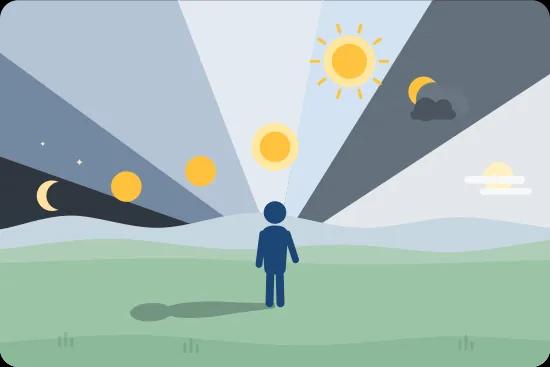
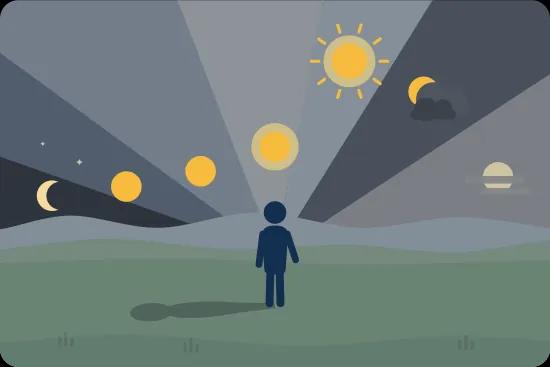
Five types follow the balance of light and shadow, from brightest to darkest: Noon, Morning, Twilight, Evening, and Night. Two more cover special cases: in Storm both sides run strong, in Mist both run quiet. No type is better than another. Each has its own strengths and its own risks.
Noon
Strong light traits, almost no shadow: honesty, respect, and faith in people.
Morning
Noticeably more light than shadow: warmth toward people, with healthy boundaries.
Twilight
Light and shadow in roughly equal measure: flexibility, a feel for the moment, and a line of your own.
Evening
The shadow runs longer than the light: clear eyes, strategy, and caution with trust.
Night
Pronounced dark traits, muted light ones: self-reliance, calculation, and nerve.
Storm
Both sides run strong: plenty of warmth and plenty of fire.
Mist
Both sides run low: reserve, steadiness, and an independent mind.
Six traits of light and shadow
- Machiavellianism9 questions
Strategy and calculation in dealing with people: keeping your cards close, managing impressions, playing the long game.
For example: “Most people help others when they can see something in it for themselves.”
- Narcissism9 questions
A need for attention, leadership, and recognition, and a sense of being special.
For example: “In a new group, I quickly end up at the center of the conversation.”
- Psychopathy9 questions
Impulsivity, a taste for risk, hitting back, and less sensitivity to other people’s feelings and to rules.
For example: “I enjoy thrills, even when they’re not entirely safe.”
- Kantianism4 questions
Treating people as ends, not means: honesty over gain, no manipulation.
For example: “I won’t lie to someone, even when the truth costs me more than a convenient lie would.”
- Humanism4 questions
Respect for every person’s dignity, admiring others, and celebrating their wins.
For example: “I can enjoy talking to a delivery driver just as much as to a company CEO.”
- Faith in humanity4 questions
The belief that people are fundamentally good, and a readiness to trust and forgive.
For example: “When someone behaves badly, I look for the reason before I write them off as a bad person.”
How the test works
- 139 statements about people and yourselfSome statements are about how you see people, others about your habits and reactions in specific situations. It usually takes about 7 minutes.
- 2As you are, not as you should beWith questions about dark traits, it’s tempting to give the respectable answer. There are no good or bad answers here, and the dark side has its useful sides too, so honesty gets you the most accurate result.
- 3A detailed result right awayAfter the last answer, you’ll see your six-trait chart, your light and shadow scores, your type, everyday situations, and a plan for the week. Save it to your account or share it as a card.
Answer options
- 1Strongly disagree
- 2Disagree
- 3Neutral
- 4Agree
- 5Strongly agree
Method and sources
Where the test comes from and how the result is scored
- What it measures
- The dark side is measured with the Dark Triad model of Paulhus and Williams (2002), using the structure of the Short Dark Triad (SD3): Machiavellianism, narcissism, and psychopathy, nine statements each. The light side follows the Light Triad of Kaufman and colleagues (2019): Kantianism, humanism, and faith in humanity, four statements each. The Light Triad’s authors paired the same two questionnaires, the SD3 and their own scale, when they compared the two sides. Light and shadow are inversely but only moderately related, so they’re scored separately, and the types allow for both sides being strong or both being faint.
- How it is scored
- Each answer scores 0 to 4. Narcissism has three reverse-scored items and psychopathy has two: on those, disagreeing points toward the trait. A trait is the average of its answers, converted to 0-100; levels are up to 37 low, 38-62 moderate, 63 and above high. The light score is the average of the three light traits, and the shadow score is the average of the three dark ones. Your type comes from both scores: if both are above 62, it’s Storm; if both are 37 or below, Mist; otherwise the gap between light and shadow decides: 40 or more is Noon, 15 or more is Morning, between -15 and 15 is Twilight, -15 or less is Evening, -40 or less is Night.
- Reliability
- 39 original statements: 27 on dark traits and 12 on light traits
- Five agreement options, as in the original questionnaires
- Reverse-scored items as in the SD3: three for narcissism, two for psychopathy
- The SD3 authors checked their scales against longer measures and ratings by acquaintances; the Light Triad’s authors call their scale a first draft
- The Prisamor version has no reliability study or norms of its own yet
- Limitations
- The models come from two published questionnaires: the Short Dark Triad (Jones & Paulhus, 2014) and the Light Triad Scale (Kaufman, Yaden, Hyde & Tsukayama, 2019). The number of items, the answer format, and the reverse-scored items match the originals, but all 39 statements were written from scratch by the Prisamor team, not translated. This version has no norms and no reliability study of its own. It is a self-report for understanding yourself, not a diagnosis.
- Sources
- Paulhus, D. L., & Williams, K. M. (2002). The Dark Triad of personality: Narcissism, Machiavellianism, and psychopathy. Journal of Research in Personality, 36(6), 556-563.
- Jones, D. N., & Paulhus, D. L. (2014). Introducing the Short Dark Triad (SD3): A brief measure of dark personality traits. Assessment, 21(1), 28-41.
- Kaufman, S. B., Yaden, D. B., Hyde, E., & Tsukayama, E. (2019). The Light vs. Dark Triad of Personality: Contrasting Two Very Different Profiles of Human Nature. Frontiers in Psychology, 10, 467.
Who it suits
- Anyone who wants an honest look at their dark side without forgetting the light one
- People curious why they’re gentle in some situations and tough in others
- Readers who know the Dark Triad and want to see their own traits on a chart
- Managers and anyone who works with people and wants to understand their style
Practical Value
- A six-trait chart plus light and shadow scores
- One of seven types: strengths, risks, and how you are with people, at work, and in love
- Each of the six traits broken down by level, with a step for the week
- Your most telling answers, explained, with small actions to try
- Four everyday situations and a seven-day plan
Light vs Dark Triad Test: Your Balance on a 6-Trait Chart
What are the Dark Triad and the Light Triad?
Psychologists use the term Dark Triad for three traits that ordinary people have to different degrees: Machiavellianism, narcissism, and psychopathy. Delroy Paulhus and Kevin Williams coined it in 2002 and described the traits as unpleasant but not pathological: a behavioral style, not a diagnosis. In 2019, Scott Barry Kaufman and colleagues proposed the Light Triad to describe the other side: everyday goodwill toward people, which is more than the absence of dark traits.
Machiavellianism, narcissism, and psychopathy
Machiavellianism shows up as calculation and strategy in dealing with people: keeping your cards close, managing impressions, playing the long game. Narcissism is about the need for attention, leadership, and recognition. Psychopathy as a trait means impulsivity, a taste for risk, a readiness to hit back, and less sensitivity to other people’s feelings. The traits overlap, and all three have a common core: low agreeableness. Each also has its practical uses, from strategic thinking to nerve.
Kantianism, humanism, and faith in humanity
Kantianism means treating people as ends, not means: no lying for gain and no manipulation. Humanism means valuing every person’s dignity regardless of status, and being genuinely glad when others succeed. Faith in humanity is the tendency to see the good in people and to forgive. The light side has its risks too: naivety, trouble saying no, and burnout from carrying other people’s problems.
Light and dark in the same person
It feels natural to picture light and dark as one scale, where more of one means less of the other. Kaufman and colleagues found that the two are inversely related, but only moderately, and that the absence of dark traits doesn’t necessarily mean the presence of light ones. The same person can be strong on both sides or low on both. In their samples, most participants’ light side came out higher than their dark side.
What this light vs dark triad test shows
The test scores six traits separately and plots them on a chart, then calculates two scores: light and shadow. Their balance gives you one of seven types named after times of day. Noon, Morning, Twilight, Evening, and Night run from bright light to deep shadow; Storm describes both sides running strong, and Mist both running quiet. Each type comes with a breakdown of how you are with people, at work, and in love, four everyday situations, and a week of small steps.
How to read your result
Your type doesn’t sort people into good and bad: dark traits have useful sides, and light traits have weak spots of their own. The result describes your answers right now, with no comparison to norms, and it doesn’t diagnose anything. If you want to dig deeper into the dark side alone, the site also has the D70 test, which measures a general dark factor and nine dark traits.
Common questions about the Light and Dark Triads
What are the Dark Triad and the Light Triad?
The Dark Triad groups three traits: Machiavellianism (calculation and manipulation), narcissism (a need for attention and admiration), and psychopathy (impulsivity and emotional toughness). Paulhus and Williams named it in 2002. The Light Triad was described by Kaufman and colleagues in 2019: Kantianism (not using people), humanism (valuing every person’s dignity), and faith in humanity.
Can you be both light triad and dark triad?
Yes. In Kaufman and colleagues’ study, the Light and Dark Triads were inversely related, but only moderately, and the authors stress that the absence of darkness doesn’t necessarily mean the presence of light. That’s why this test scores the two sides separately. If both are strong, your type is Storm; if both are faint, it’s Mist.
How is this different from the D70 test?
The D70 test on this site takes a wider look at the dark side: it measures a general dark factor and nine dark traits, three of which are the Dark Triad. This test does something else: it puts the Dark Triad next to the Light Triad and shows the balance between them. If you want the dark side in all its shades, take the D70. If you want to know which side outweighs the other, take this one.
Is this test scientific?
It’s built on two published models: the Short Dark Triad (Jones & Paulhus, 2014) and the Light Triad Scale (Kaufman et al., 2019). The scale structure and answer format follow the originals, while the statements were written from scratch by Prisamor. Our version has no reliability study or norms of its own, and the Light Triad’s authors themselves call their scale a first draft. So the result describes your answers and doesn’t diagnose anything.
What does a high psychopathy score mean?
Here, psychopathy is measured as a personality trait in ordinary people, not as a disorder. A high score means you’re drawn to risk and thrills, act fast, can hit back hard, and aren’t much moved by other people’s feelings. The trait has a strong side, nerve in tough situations, and a cost that relationships usually end up paying. A self-report can’t diagnose anyone.
Do these traits change over time?
Yes, they’re not a life sentence. Traits shift with age, experience, and circumstances: after being let down by people, your faith in them may dip, and in a calmer stretch it can come back. Your answers reflect where you are now, so a few months from now your result may look different.
Why two scores instead of one?
Light and shadow aren’t two ends of one ruler. A single “how dark are you” percentage would hide the most interesting part: someone can have a lot of both, or little of either. Two scores from 0 to 100 and the gap between them give a more honest picture. The scores describe your answers, not where you stand among other people: the test has no norms.
See your own balance of light and shadow
39 statements, about seven minutes. As soon as you answer the last one, you’ll get two scores, a six-trait chart, your type out of seven, and a week of small steps.
Free, no sign-up needed.