Am I the Abuser?
Pressure from Both Sides on One Chart
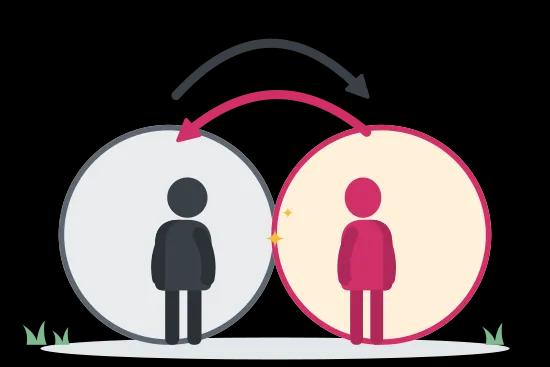
Forty questions about the past year: control and bans, mockery, the silent treatment, threats, gaslighting, money and physical force. Each behavior is asked about your partner and about you, and the chart shows who puts on the pressure and how.
What you get
The report opens right after the test, and you can save it to your profile
- A mirror chart of pressureSeven forms, each with two bars: to the left what your partner does, to the right what you do. Every bar has a percentage, so you can see at a glance who applies pressure and how.
- Two indexes and a levelPressure on you and your pressure, each from 0 to 100. The level also weighs single dangerous answers, so one threat doesn’t get lost in an average.
- One of five profilesEqual footing, rough edges, under pressure, pressure from your side or a two-way spiral. No labels, just an honest description of behavior.
- Each form and your most telling answersWhat each form means at your level, plus up to three of your most telling answers on each side: what they say and one small step to try.
- What it looks like day to dayHome, friends, money, fights and phones: where things are calm for you and where pressure is already showing.
- A week’s plan and where to get helpSeven steps tailored to your profile. If your answers include force or threats, the safety section opens first.
Five profiles, from equal footing to a spiral
Your profile depends on which side the pressure comes from and how strong it is. Equal footing and rough edges have no pattern of pressure. Under pressure means your partner applies it, pressure from your side means the opposite, and in a two-way spiral you both do. The words abuser and victim never appear in the result: behavior can be named and changed, while a label explains nothing.
Equal footing
No pressure from either side: you argue, but you don’t break each other down.
Rough edges
Sharp words and hurt feelings happen, but there’s no pattern of pressure.
Under pressure
The pressure comes mostly from your partner: control, put-downs, fear or blame form a pattern.
Pressure from your side
The pressure comes mostly from you: control, coldness, threats or blame keep repeating.
Two-way spiral
Pressure runs both ways about equally: harshness, coldness and threats have become how you argue.
Seven forms of pressure in a couple
- Control and isolation
- No pressure
- trust: each of you has your own people and your own phone
- Pressure
- checking, bans and reporting where you are and with whom
- Humiliation and mockery
- No pressure
- arguments about actions, not about the person
- Pressure
- insults, mockery in front of others, “so what?”
- Punishing coldness and silence
- No pressure
- a pause after a fight, then a conversation
- Pressure
- silence for days until someone apologizes
- Intimidation and threats
- No pressure
- anger happens, fear doesn’t
- Pressure
- yelling that scares, broken things, threats
- Blame shifting and gaslighting
- No pressure
- each person owns what they said
- Pressure
- “that never happened” and “you make me like this”
- Financial control
- No pressure
- each of you has money of your own
- Pressure
- a receipt for every purchase, obstacles to working
- Physical force and coercion
- No pressure
- the other person’s body is off limits
- Pressure
- shoving, hitting, pressure for intimacy
- How to read the percentages
Each answer scores from 0 (never) to 4 (all the time). A form is the average of its questions as a percentage from 0 to 100: up to 25 means never or once or twice a year, up to 50 sometimes, above that often. Each side’s index is the average of the seven forms. This isn’t a comparison with other people: the quiz has no norms.
How the test works
- 140 questions about the past year in your relationshipThink about your current relationship, or your last one if you’re single now. Each question has five answers, from never to all the time, including an honest once or twice. The whole quiz takes about 7 minutes.
- 2Every behavior, asked twiceFirst about your partner, then a few questions later the same thing about you. That’s how research questionnaires on couple conflict work, and it’s the only way to see which side the pressure comes from.
- 3How it was, not how you wish it had beenAnswering about your partner is easier than answering about yourself. But the breakdown only helps if both sides are honest. There are no good or bad answers here.
- 4Chart and breakdown right awayAfter your last answer you’ll see the mirror chart, two indexes, your profile, a breakdown of all seven forms, everyday situations and a plan for the week. If your answers include force or threats, the safety section comes first.
Answer options
- 1Never
- 2Once or twice
- 3Sometimes
- 4Often
- 5All the time
The method and its limits
Where the test comes from and how the result is scored
- What it measures
- The model is original. The Prisamor editorial team identified seven forms of pressure in a couple and wrote questions for each in two directions: what your partner does and what you do. That’s standard practice in research questionnaires on couple conflict: the Revised Conflict Tactics Scales, CTS2 (Straus and colleagues, 1996), and the working version of the Multidimensional Measure of Emotional Abuse, MMEA, ask about the same behavior from both sides and about how often it happened. Four of the forms are close to the MMEA factors (Murphy and Hoover, 1999): restrictive engulfment, denigration, hostile withdrawal, and dominance and intimidation. Financial control draws on the Scale of Economic Abuse (Adams and colleagues, 2008), and the level rules on the idea of coercive control (Stark, 2007): abuse is held together by a pattern, not only by violence. The profile rule follows Michael Johnson’s typology (2008), which separates violence within ongoing control from fights that get out of hand for both people and from the resistance of someone defending themselves.
- How it is scored
- Each answer scores 0 to 4. A form is the average of its questions as a percentage from 0 to 100, and each side’s index is the average of the seven forms. A side’s level comes from the most worrying of four signals: the index (up to 12 no signs, up to 30 warning signs, up to 55 looks like abuse, above that severe pressure), the highest form apart from force (42 and up warning signs, 67 and up abuse), the questions about force (once or twice already counts as a warning sign, sometimes as abuse) and any single answer (often is a warning sign, all the time is abuse). The profile combines the levels of both sides. If both sides apply pressure but one is stronger by 20 points or more, the profile goes to that side: someone who snaps back under heavy pressure doesn’t land in the two-way spiral.
- Reliability
- 40 original questions: 20 about your partner and 20 about you, in mirrored pairs
- Six forms with three questions on each side, physical force with two
- Five frequency options for the past year, from “never” to “all the time”
- The level weighs single dangerous answers, not just the average
- The quiz has no norms or reliability data yet
- Limitations
- The method is original: the seven forms, 40 questions and scoring rules were written by the Prisamor editorial team using research questionnaires as reference points, and none of them is reproduced. There are no norms or reliability data, so the percentages describe your answers, not where you stand compared with others. It’s one person’s view: even in research, partners describe the same events differently. The quiz doesn’t diagnose, doesn’t decide who’s to blame and doesn’t assess danger the way professionals do.
- Sources
- Murphy, C. M., & Hoover, S. A. (1999). Measuring emotional abuse in dating relationships as a multifactorial construct. Violence and Victims, 14(1), 39-53. DOI 10.1891/0886-6708.14.1.39
- Straus, M. A., Hamby, S. L., Boney-McCoy, S., & Sugarman, D. B. (1996). The Revised Conflict Tactics Scales (CTS2): Development and preliminary psychometric data. Journal of Family Issues, 17(3), 283-316. DOI 10.1177/019251396017003001
- Adams, A. E., Sullivan, C. M., Bybee, D., & Greeson, M. R. (2008). Development of the Scale of Economic Abuse. Violence Against Women, 14(5), 563-588. DOI 10.1177/1077801208315529
- Stark, E. (2007). Coercive Control: How Men Entrap Women in Personal Life. New York: Oxford University Press. DOI 10.1093/oso/9780195154276.001.0001
- Johnson, M. P. (2008). A Typology of Domestic Violence: Intimate Terrorism, Violent Resistance, and Situational Couple Violence. Boston: Northeastern University Press. ISBN 978-1-55553-693-0
- Johnson, M. P., & Leone, J. M. (2005). The differential effects of intimate terrorism and situational couple violence: Findings from the National Violence Against Women Survey. Journal of Family Issues, 26(3), 322-349. DOI 10.1177/0192513X04270345
- Tolman, R. M. (1989). The development of a measure of psychological maltreatment of women by their male partners. Violence and Victims, 4(3), 159-177. DOI 10.1891/0886-6708.4.3.159
- Walker, L. E. (1979). The Battered Woman. New York: Harper & Row.
- Sweet, P. L. (2019). The sociology of gaslighting. American Sociological Review, 84(5), 851-875. DOI 10.1177/0003122419874843
Who it suits
- Anyone asking “am I the abuser or the victim?” who wants to see both sides
- People who suspect their fights stopped being just fights a while ago
- Anyone worried they’re the one applying pressure and wanting an honest check
- Couples where both feel safe: take it separately and compare charts
- Friends and family trying to understand what’s happening to someone they love
Practical Value
- A mirror chart of seven forms and two indexes from 0 to 100
- One of five profiles: what’s happening, what to lean on, intimacy, everyday life, friends
- Each form broken down by level from both sides, plus your most telling answers with a small step
- How to tell a fight from abuse, signs of pressure and the cycle of abuse without the myths
- A plan for the week and a safety section if your answers include force or threats
Abuse in a relationship: how to tell it from a fight
What abuse in a relationship is, and how it differs from conflict
Abuse is a pattern in which one person in a couple gains power over the other: deciding for them, frightening, belittling, punishing with coldness, restricting money and social life. A fight works differently: two people disagree about an issue, both can push back, and nobody is afraid of the other. Abuse doesn’t start with volume or with one harsh word. It starts with an imbalance that keeps repeating. That’s why the quiz doesn’t ask “has this ever happened?” but how often it happened over the past year.
According to WHO estimates, almost one in four women who have been in a relationship have experienced physical or sexual violence from a partner at least once. Psychological abuse isn’t included in those estimates: WHO doesn’t put a number on it. Pressure in a relationship happens to people of any gender and in any kind of couple, which is why the quiz simply says partner.
Seven forms of pressure, from control to physical force
Researchers of emotional abuse describe several forms of it, and study financial abuse and coercive control, which can exist without physical violence, separately. The quiz gathers them into seven forms, each with its own row on the chart.
- Control and isolation: checking your phone, bans on seeing people close to you, reporting where you are and with whom.
- Humiliation and mockery: insults, hurtful names, mockery in front of others, “so what?” in response to good news.
- Punishing coldness: silence for days, withholding warmth and intimacy, pointed ignoring.
- Intimidation and threats: yelling that frightens, thrown or broken things, threats to leave, to hurt someone or to take the kids.
- Blame shifting and gaslighting: “that never happened,” “you make me like this,” retellings that leave you doubting your memory.
- Financial control: a receipt for every purchase, obstacles to work or study, money and cards in one person’s hands.
- Force and coercion: shoving, grabbing, hitting, intimacy under pressure.
Why this quiz asks about both of you
Research questionnaires on couple conflict usually ask about the same behavior twice: what your partner does and what you do. The Revised Conflict Tactics Scales (CTS2) and the working version of the MMEA are built this way. We use the same approach with our own questions. It’s the real answer to “am I the abuser or the victim?”: pressure is almost impossible to see from one side. People under pressure often blame themselves, while the person applying it often sees themselves as the injured one. The mirrored questions are spread through the quiz so an answer about your partner doesn’t nudge your answer about yourself.
How to read the mirror chart
The names of the seven forms run down the middle. Bars to the left show “partner → you”, bars to the right “you → partner”. The number on each bar shows how often that form happens, from 0 to 100: up to 25 means never or once or twice a year, up to 50 sometimes, above that often. Each side’s index is the average of the seven forms, and the level also weighs single dangerous answers, so one shove or a threat marked “all the time” doesn’t disappear into an average.
Read the overall shape, not just the numbers. A long left side next to a short right side means pressure on you, and the mirror image means pressure from you. If both are long, it’s a spiral, and then the key question is whether one of you is afraid of the other.
Abuser, victim or both: the five result profiles
- Equal footing: no pressure from either side, and disagreements get settled by talking.
- Rough edges: fights can be sharp, but there’s no pattern of pressure.
- Under pressure: the pressure comes mostly from your partner: control, put-downs, fear or blame form a pattern.
- Pressure from your side: the same picture, but the pressure comes from you.
- Two-way spiral: you both apply pressure about equally, and harshness has become how you argue.
The words abuser and victim never appear in the result. A label explains nothing, while behavior can be named, noticed and changed.
Reacting to abuse is not the same as abuse: reactive abuse
People under long-term pressure snap too: they yell back, check the phone of the person who checks theirs, go silent. Popular articles call this reactive abuse. Sociologist Michael Johnson distinguishes violence within ongoing control, fights that get out of hand for both people, and the resistance of someone defending themselves. The quiz accounts for this: if both sides apply pressure but one is stronger by 20 points or more, the profile goes to that side rather than to the two-way spiral.
That doesn’t make snapping back safe, especially when it involves force. But the question “who is afraid of whom?” usually says more about a couple than any score.
Gaslighting and financial control: the forms that are easy to miss
Gaslighting is pressure that leaves a person unable to trust their own memory and perception: “that never happened,” “you’re imagining things,” “you always get it wrong.” Sociologist Paige Sweet describes it as an expression of power in a relationship, not an ordinary difference in how people remember things. If you leave conversations with your partner doubting yourself more and more, take a closer look.
Financial abuse often looks like care or good housekeeping: an account of every purchase, “you don’t need to work,” a shared account only one person controls. Adrienne Adams and colleagues created a separate Scale of Economic Abuse because no such scale existed before. Without money of your own, every decision gets harder, including the decision to leave.
The cycle of abuse, and why not every relationship follows it
In 1979 psychologist Lenore Walker described three phases that often repeat in violent relationships: tension builds, an outburst happens, then comes reconciliation with apologies and promises. Later popular versions added a fourth phase, calm.
Today the cycle is criticized: many couples never have a reconciliation phase, and the tension can stay high for weeks. If you don’t recognize this cycle, that doesn’t mean there’s no pressure. The quiz looks at how often each form happens, not at the cycle.
If you are under pressure, and if the pressure comes from you
If you’re under pressure, start with support outside the relationship: tell someone you trust, find out where you can turn in your country, think through where you’d go if you got scared. If there’s force or threats in the relationship, a heart-to-heart with your partner can be dangerous, and professionals generally advise against couples therapy while violence is ongoing. If your answers include these signs, the breakdown starts with a safety section.
If the pressure comes from you, the first step is to name your behavior without excuses and give up the form of pressure you use most. Control doesn’t ease anxiety. It only muffles it for a while. Change is real when a person takes responsibility and works with a professional who specializes in anger and abusive behavior. Promising “it won’t happen again” isn’t enough.
What the quiz is based on and what it cannot tell you
The model is original. Reference points: the Multidimensional Measure of Emotional Abuse, MMEA (Murphy and Hoover, 1999), the Revised Conflict Tactics Scales, CTS2 (Straus and colleagues, 1996), the Scale of Economic Abuse (Adams and colleagues, 2008), coercive control (Stark, 2007) and the typology of intimate partner violence (Johnson, 2008). The wording and scoring rules are our own and there are no norms, so the quiz isn’t labeled as scientific.
The quiz doesn’t diagnose, doesn’t decide who’s to blame and doesn’t assess danger the way professionals do. It shows which behaviors happen in your relationship and from which side. If you’re afraid, contact a helpline even if your result looks calm.
Common questions about relationship abuse
How do I know if I’m the abuser?
Look for a pattern rather than a single outburst. Abuse means you regularly get your way through control, fear, put-downs, coldness or guilt, and your partner adjusts to you and fears your reaction. The quiz asks twenty questions about your own behavior and shows your pressure index and the form that comes up most. If you choose your words carefully and snap out of desperation because you’re the one under pressure, that’s closer to self-defense than abuse, and the breakdown says so plainly.
How do I know if I’m in an abusive relationship?
The main signs: you predict your partner’s reactions in advance, apologize to end a silent treatment, see friends and family less and less, account for money and plans, and doubt your own memory. There may be no bruises at all: control, humiliation and threats do damage without physical force. The quiz measures how often these things happened over the past year and gives extra weight to single dangerous answers, such as threats or a shove.
What’s the difference between an argument and abuse?
In an argument, two people disagree about an issue, both can push back, and nobody walks on eggshells afterward. In abuse, the argument quickly turns into a question of who’s in charge: one person decides, frightens or punishes, and the other learns to stay quiet. Volume has nothing to do with it. What matters is an imbalance that keeps repeating. That’s why the quiz has a separate Rough edges profile: sharp fights without a pattern of pressure aren’t counted as abuse.
Am I abusive, or is it reactive abuse?
Popular articles use the term reactive abuse for someone’s sharp response to long-term pressure: yelling back, an insult, trying to break free. Sociologist Michael Johnson separates this kind of resistance from the violence that keeps one partner in control. The quiz accounts for the difference: if the pressure on you is clearly stronger than yours, your profile is Under pressure, not Two-way spiral. Snapping back is still worth noticing, especially when it involves force.
Can abuse be mutual?
Sometimes both people apply pressure: checking up, hurting, freezing each other out, frightening. The quiz calls this a two-way spiral. But similar numbers don’t always mean an even fight, so the breakdown asks one key question: is one of you afraid of the other? If you’re the one who’s afraid, Under pressure is closer to the truth. If there’s physical force in the relationship, safety comes first and working on the relationship comes later.
Can we take this quiz as a couple?
You can’t take it on your partner’s behalf: half the questions are about a person’s own behavior, and only they can answer those honestly. Taking it separately and comparing charts is fine if you don’t feel afraid around your partner. If there are threats or force in the relationship, suggesting the quiz and comparing results isn’t safe. Show your chart to someone you trust instead.
Can an abusive partner change?
Yes, if they admit the problem, take responsibility with no buts and work with a professional who specializes in anger and abusive behavior. Promises that it won’t happen again aren’t enough: change shows in the other person feeling calmer around them. Love and compliance from the partner don’t cure pressure. If you’re the one under pressure, you don’t have to wait for change alone, or nearby.
Is this an official test or a diagnosis?
No, it’s not a diagnosis or a legal assessment. The method is original: the questions and scoring rules are our own, the reference points come from research questionnaires on intimate partner abuse, and the quiz has no norms. The result describes behavior based on your answers and sees the relationship from your side only. If you’re afraid, contact a helpline even if your result looks calm.
See what’s really going on between you
40 questions, about seven minutes. Right after your last answer you’ll see a mirror chart of seven forms of pressure, two indexes from 0 to 100 and your profile: equal footing, rough edges, under pressure, pressure from your side or a two-way spiral. Only you see the result unless you choose to share it.
Free, no sign-up needed.